 element30
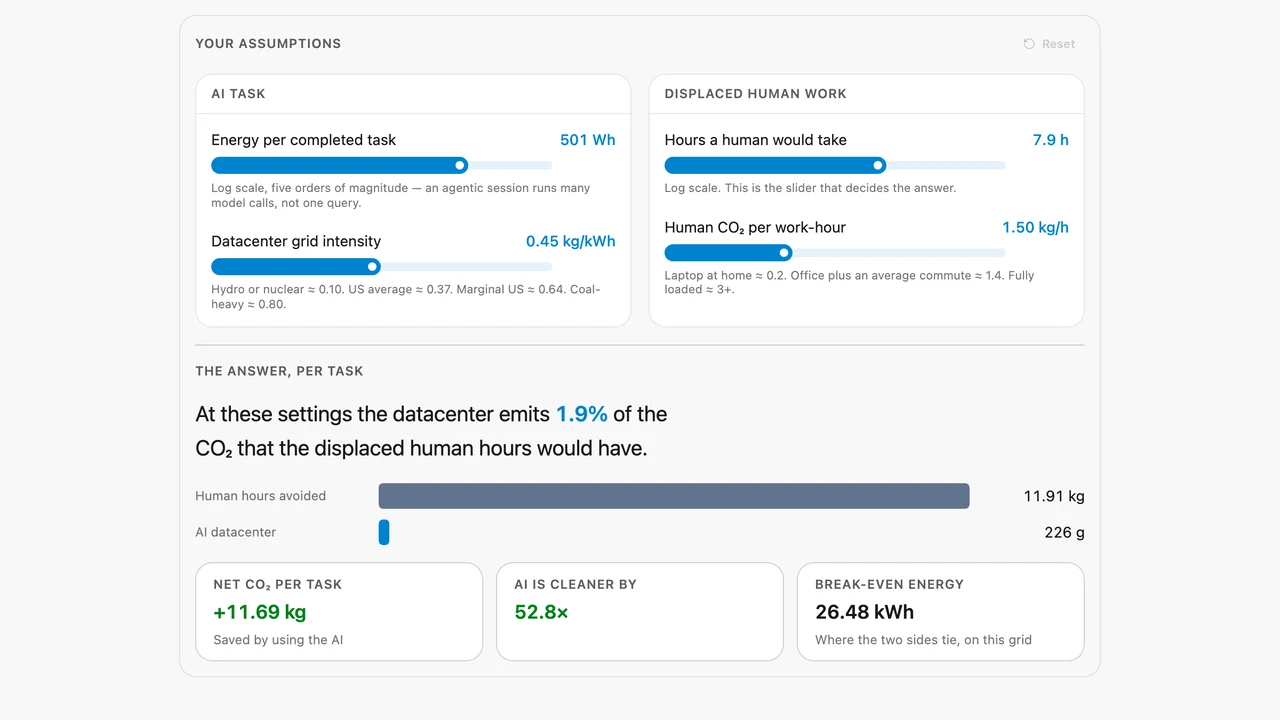
Every version of this argument comes down to four numbers, and the defensible range for them spans about five orders of magnitude. So Watt If puts all four on sliders, does the two multiplications, and gets out of the way — no answer it's trying to sell you, and every figure sourced so you can check it.
Start from a task
Pick a real job — answer a question, translate a document, review a contract, build a feature — and the two numbers nobody can guess cold fill themselves in.
Four sliders, live
Compute, grid intensity, human hours, and human carbon. Both bars and the verdict recompute as you drag.
The answer, three ways
Net CO₂ per task, how many times cleaner one side comes out, and the break-even energy where the two tie.
Sourced defaults
Seventeen task presets and four slider defaults, each with the paper or tracker it came from and an argument for the number.
Log scales where it matters
The inputs that span orders of magnitude get logarithmic sliders, so the whole defensible range stays reachable.
Says what it leaves out
Hardware manufacturing, training amortization, water, retries, and whether the displaced hours actually disappear — stated up front, not buried in a footnote.
Nothing leaves your browser
No server, no analytics, no runtime network request. Nothing you drag is recorded or sent anywhere.
Built to be argued with
A better number or a better source is the genuinely useful outcome, and there's a mailto on the page for exactly that.
Ready to try Watt If?
Put your own numbers in and see which assumption the answer actually hangs on.
Try It